
Environmental Impact of Disposable Filters
In the U.S., about 508 million disposable filters are thrown away each year. Most are made with fiberglass, plastic, synthetic fibers, or cardboard, and most can’t be recycled after use. That means many sit in landfills for years.
If I boil the article down, the main points are simple:
- Disposable filters add repeat waste because they are replaced every 1 to 3 months
- A home can throw away about 40 to 120 filters in 10 years
- Washable filters cut landfill waste because one filter can stay in use for over 10 years
- Cleaning a reusable filter uses some water, but studies still show less total waste over time
- The key trade-off is simple: you have to clean the filter on schedule
Here’s the short answer: if I want less trash from my HVAC system, a washable filter usually makes more sense as long as I keep it clean and use it long enough.
Quick comparison
| Filter type | How often I replace it | Waste over 10 years | Main trade-off |
|---|---|---|---|
| Disposable | Every 1–3 months | 40–120 filters | More landfill waste |
| Washable | About every 10+ years | 1 filter | Needs regular cleaning |
Bottom line: the article shows that the biggest drop in waste comes from using one filter for years instead of throwing one away every few months.
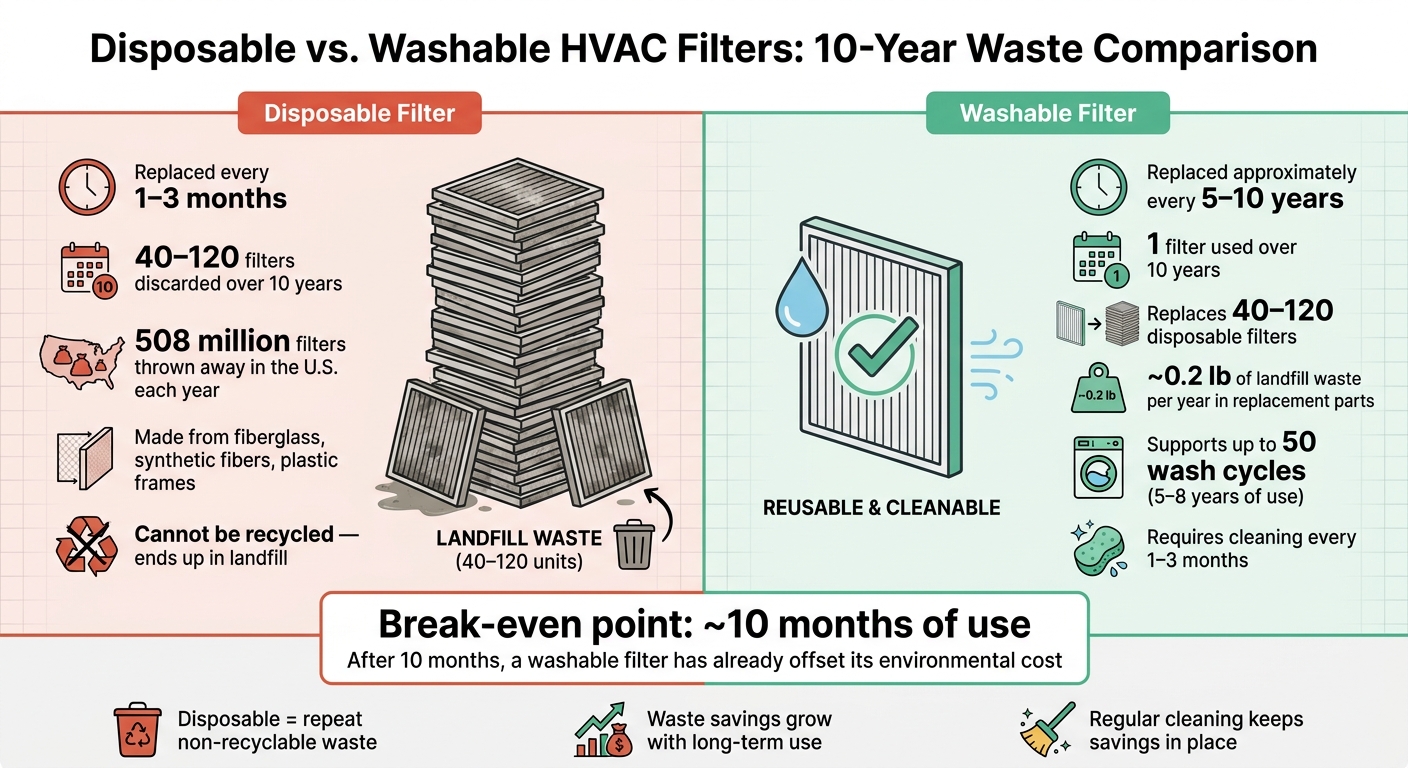
Disposable vs. Washable HVAC Filters: 10-Year Waste Comparison
Disposable filters create repeat landfill waste because you have to swap them out every 1 to 3 months.
Frequent Replacement Adds Up Over Time
Most HVAC guidance says to replace a disposable filter every 1 to 3 months. Over 10 years, that works out to 40 to 120 discarded filters. And across the life of a heating and cooling system, that pile can get big fast.
| Filter Type | Replacement Frequency | 10-Year Waste Impact |
|---|---|---|
| Disposable | Every 1–3 months | 40–120 filters discarded |
| Reusable | Every 10+ years | 0 filters discarded |
Why Most Used Filters Cannot Be Recycled
Most disposable filters use non-recyclable materials such as fiberglass or synthetic fibers, and they often come with plastic frames. Once a filter has been used, it’s also filled with trapped dust and debris. That makes recycling even harder in practice.
Most curbside recycling programs don’t take these filters, so they usually end up in landfills. And once they’re there, they can take decades to break down. That’s the waste problem washable filters are meant to cut down.
Lifecycle Impacts of Washable Filters
Landfill space is only part of the story. When you look at a filter's full life - from raw materials to disposal - washable filters usually come out ahead. Lifecycle studies show they tend to use fewer resources overall and create less waste across the years, even though the impact shifts a bit from one stage to another.
| Lifecycle Stage | Disposable Filters | Washable Filters |
|---|---|---|
| Manufacturing | New unit produced every few months | One unit lasts for years |
| Transportation | Repeated shipments over the filter's life | Typically one shipment per filter |
| Use phase | No maintenance required; replaced when dirty | Requires periodic cleaning every month |
| Cleaning | Not applicable | Modest water use and, in some cases, mild detergent |
| End-of-life | Lower total disposal volume over the filter's lifespan | Less total landfill volume because one unit replaces many disposables over time |
Where Reusable Filters Cut Waste
The biggest win comes from stopping the replace-and-toss pattern. Instead of buying a new filter every few months, you keep using the same one for years. Research shows a single reusable filter can replace dozens of disposable filters over its life.
Residential lifecycle data points the same way. Annual landfill waste dropped from about 2.4 lb to 0.2 lb in replacement parts.
The next issue is cleaning. Does that water use cancel out the waste savings?
Cleaning and Maintenance Trade-Offs in the Research
It can add some impact, but not much when the filter is cared for the right way.
Cleaning uses a bit of water, sometimes mild detergent, and some drying time. Still, studies show that washing the filter every month with moderate water pressure is enough to keep it working as intended. Even after counting those inputs, lifecycle analyses still find that reusable filters have a much lower overall carbon footprint and waste output than disposables.
The main downside shows up when maintenance goes off track. Experts warn that hot water, high-pressure spraying, or energy-heavy drying can damage the filter media and shorten how long the filter lasts. And if cleaning gets skipped for too long, performance can drop and the filter may need to be replaced sooner than expected.
So the gains are tied to a simple habit: clean the filter on schedule to keep both performance and waste reduction in place.
sbb-itb-adeab55
Study Findings on Performance and Long-Term Waste Reduction
The research points to one main takeaway: a longer service life leads to the biggest drop in waste. When a washable filter is cleaned on a regular schedule, it keeps dozens of disposable filters out of the landfill over the years.
What the Evidence Says About Reusable Furnace Filtration
Lifecycle comparisons show that one washable filter can last about 10 years and replace roughly 40 to 120 disposable filters during that time. That's a big deal because most disposable filters are made from non-recyclable materials such as fiberglass, synthetic fibers, and plastic frames. Those materials usually end up in landfills.
| Study/Analysis Type | Main Finding | Waste-Reduction Implication |
|---|---|---|
| Lifecycle waste comparison | One washable filter can last 10 years and replace 40–120 disposables | Far fewer non-recyclable units sent to landfill |
How ElectroDust Matches the Waste-Reduction Pattern
ElectroDust fits this same pattern. It uses a 10-year washable design that cuts how often the filter needs to be replaced.
Conclusion: Key Takeaways for Lower-Waste Home Filtration
Disposable filters create a steady stream of non-recyclable waste because most need replacement every 1–3 months. In the U.S., some estimates put that total at 508 million filters thrown away each year. And when disposable filters get clogged, they can also push energy use up.
The big win comes from replacing filters less often. Washable filters cut waste only if you keep using them over time and clean them on a regular schedule. In most cases, the break-even point shows up after about 10 months of use.
The research comes down to three plain takeaways:
- Disposable filters create repeat, non-recyclable waste.
- Waste savings grow with long-term use.
- Regular cleaning keeps those savings in place.
So the deciding factor is maintenance. The lowest-waste option is the filter that stays in service long enough to replace several disposable ones.
FAQs
How much water does a washable filter use?
The available information doesn’t give an exact amount of water needed to clean a washable filter. In most cases, maintenance just means rinsing it with water. If it’s extra dirty, you might use a mild detergent or a high-pressure hose.
Even without a precise water-use figure, washable filters are still presented as the more sustainable option. That’s because disposable filters use a lot of water and energy during manufacturing, packaging, and transportation.
When does a washable filter become the lower-waste option?
A washable filter turns into the lower-waste choice the moment it takes the place of a disposable one. Over a 5- to 10-year lifespan, it can replace 20 to 60 disposable filters.
That adds up fast. Disposable filters are often made from non-recyclable materials like fiberglass and synthetic fibers. So when you switch to a reusable ElectroDust filter, you keep dozens of used filters out of landfills.
What happens if I don’t clean a washable filter on time?
If you wait too long to clean a washable filter, dust and debris can clog the filter media and choke off airflow to your HVAC system.
That puts your system under more strain. It has to work harder, uses more energy, and can push your utility bills up. Over time, that extra stress may also lead to system damage.
There’s another issue too: a clogged filter stops doing its job as well. Instead of trapping dust, mold, and allergens, it can let more of those particles circulate through your home.