

Do Furnace Filters Remove VOCs?
Standard furnace filters do not remove VOC gases. My advice: reduce sources such as paints and cleaners first, then ventilate when outdoor air is safe. For gas filtration, use activated carbon tested for the VOCs you want to reduce - not just a filter labeled “odor control.”
Here’s what I’d check:
- Particle filters: Washable filters, including ElectroDust, trap dust, pollen, and pet dander. A MERV 7 rating measures particle filtration, not VOC removal.
- Carbon media: Results depend on the chemical, carbon amount, airflow, humidity, and replacement timing. Carbon does not remove every VOC.
- Fit and upkeep: Stay within your HVAC system’s airflow limits, follow cleaning instructions, and replace carbon on schedule. <u>Odor alone is not a reliable replacement guide.</u>
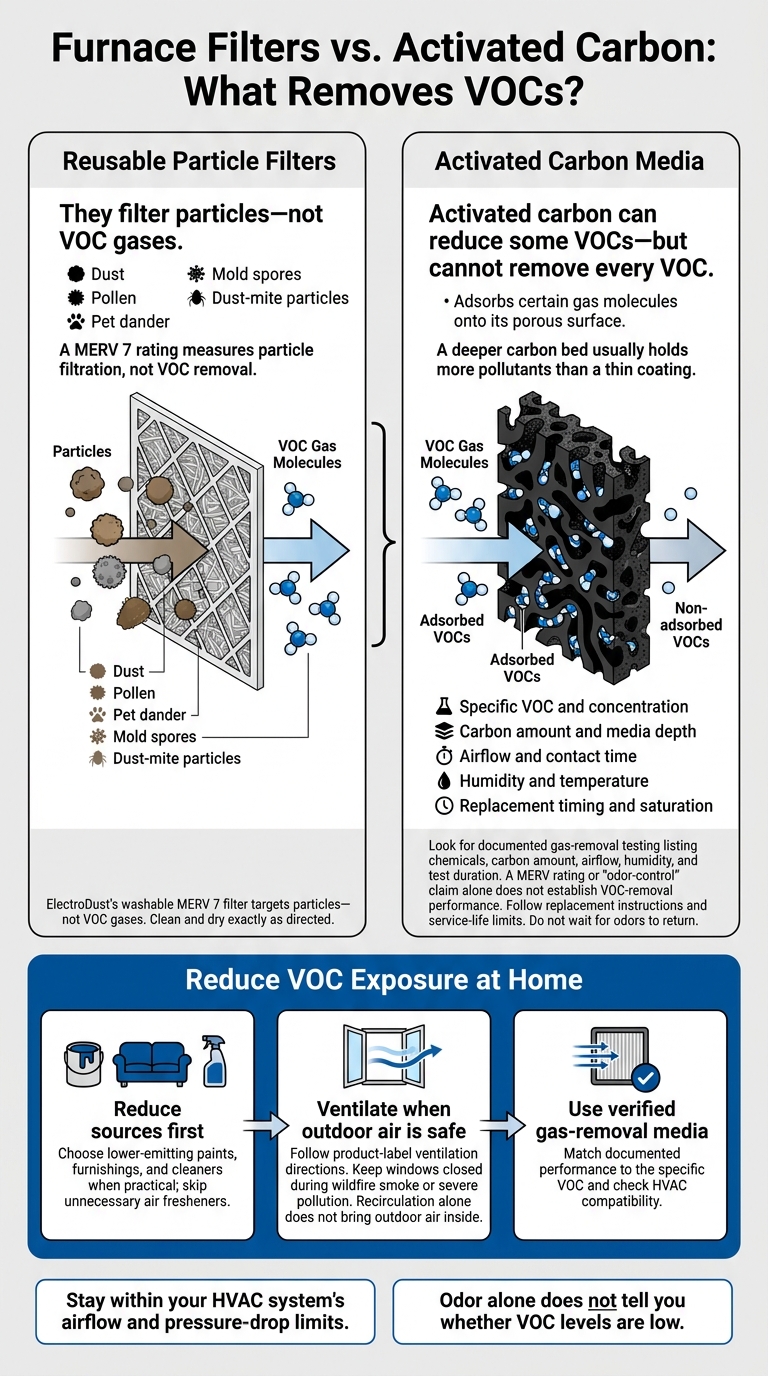
Furnace Filters vs. Activated Carbon: What Removes VOCs?
How to Reduce VOCs in Home: What Actually Works (and 3 Myths That Don't)
sbb-itb-adeab55
Can Activated Carbon Filters Reduce VOCs?
Activated carbon can reduce some VOCs by adsorbing certain gas molecules onto its porous surface, but it cannot remove every VOC. Carbon media target specific pollutants - not every household gas. Performance depends on media depth, airflow, and timely replacement.
Carbon Amount, Contact Time, and Replacement
The amount of carbon matters. A deeper carbon bed usually holds more pollutants than a thin coating, which may reduce odors only briefly. Air also needs enough contact time with the media. Results vary with the VOC, its concentration, humidity, temperature, and airflow.
Carbon can add a gas-removal layer, but it needs suitable media and enough capacity. Gas removal is not the main job of standard reusable filters. Before buying, look for documented gas-removal testing that lists the chemicals, carbon amount, airflow, humidity, and test duration. A MERV rating or “odor-control” claim alone does not establish VOC-removal performance. Check that the added media fits your HVAC system and will not restrict airflow beyond the system’s limits.
Follow the product’s replacement instructions and stated service-life limits. Continuous emissions or high VOC levels can use up the carbon’s capacity sooner. Do not wait for odors to return. Carbon can lose effectiveness without looking different, and odor alone does not tell you whether VOC levels are low.
Most reusable furnace filters still work best on particles, not gases.
What Do Reusable Furnace Filters Remove?
Reusable furnace filters trap particles such as dust, pollen, pet dander, mold spores, and dust-mite particles. They filter particles - not VOC gases.
ElectroDust’s washable MERV 7 filter targets dust mites, pollen, pet dander, and mold spores - particle claims, not VOC-removal claims.
A washable filter does not necessarily remove VOCs.
Reusable Particle Filters vs. Gas-Removal Media
Reusable particle filters trap solids. Gas-adsorbing media target VOCs and odors. They aren’t interchangeable: VOC control requires separate gas-removal media.
Before reinstalling a reusable filter, clean and dry it exactly as directed.
How to Reduce VOC Exposure at Home
Filters address only part of the problem. Reduce VOCs at the source, then ventilate as directed.
Limit VOC Sources and Ventilate Safely
Start by reducing emissions. Choose lower-emitting paints, furnishings, and cleaners when practical, and skip unnecessary air fresheners. Keep paints, solvents, and fuels tightly sealed in their original containers, away from heat and occupied rooms. Follow product-label instructions for storing and disposing of used rags.
When painting or cleaning, vent air outdoors as the label directs and keep people out of the area. Continue ventilation for the time listed on the label. When practical, air out new furnishings in a ventilated space. During painting, cleaning, or renovations, source control matters more than filtration.
Check outdoor air quality before opening windows. Keep windows closed during wildfire smoke or severe pollution, then reopen them when conditions improve. Recirculating indoor air alone does not bring outdoor air inside.
Once you’ve addressed the sources, match the filter to both the pollutant and your system.
Check Filter Fit, Airflow, and Maintenance
If you add carbon media to control gases, ask for documented performance against the specific VOCs you’re concerned about. Also request details on media capacity, replacement timing, airflow, and pressure-drop limits.
For particle control, choose a MERV rating that fits your system’s airflow limits. Check the filter’s size, thickness, and edge seals, and inspect, clean, or replace it on schedule.
Conclusion: Match the Filter to the Pollutant
Furnace filters target particles, not VOC gases. Activated carbon can reduce some VOCs, but its performance depends on media depth, airflow, contact time, the specific VOC, and how saturated the carbon is.
Washable filters such as ElectroDust remove dust, pollen, and pet dander. Washing them doesn't turn them into gas filters.
For VOC control, reduce emissions at the source, ventilate with outdoor air when conditions allow, and use verified gas-removal media.
FAQs
How can I check my home's VOC levels?
Use dedicated VOC sensors or TVOC monitors to check VOC levels in your home. Watch for headaches, dizziness, or respiratory irritation. These symptoms may point to elevated VOC levels, especially if they ease when you increase ventilation. Keep air flowing and monitor indoor conditions to help manage your VOC exposure.
Can I use carbon media with a washable filter?
The provided information does not confirm whether carbon media can be used with ElectroDust washable filters.
Activated carbon can help neutralize gaseous VOCs. ElectroDust filters, meanwhile, use electrostatic technology and layered media to trap airborne particles, including dust, pollen, pet dander, and mold spores. They’re designed for regular washing with mild soap and water.
How do I verify a filter’s VOC-removal claims?
Check whether the filter contains activated carbon to help remove gaseous VOCs, such as paint fumes. Standard HVAC filters mainly trap particles, including those carrying VOC residues. They don’t directly remove VOCs in gas form.
To manage indoor air quality, pair high-quality particle filtration with proper ventilation and control of VOC sources to reduce indoor buildup.